
How Did I End Up Committed to All This?
You’re not overwhelmed because you don’t care enough. You may be overwhelmed because you care so much that you keep saying yes before you’ve had time to decide.
The Free Guide for Thoughtful Women Who Say Yes Too Fast
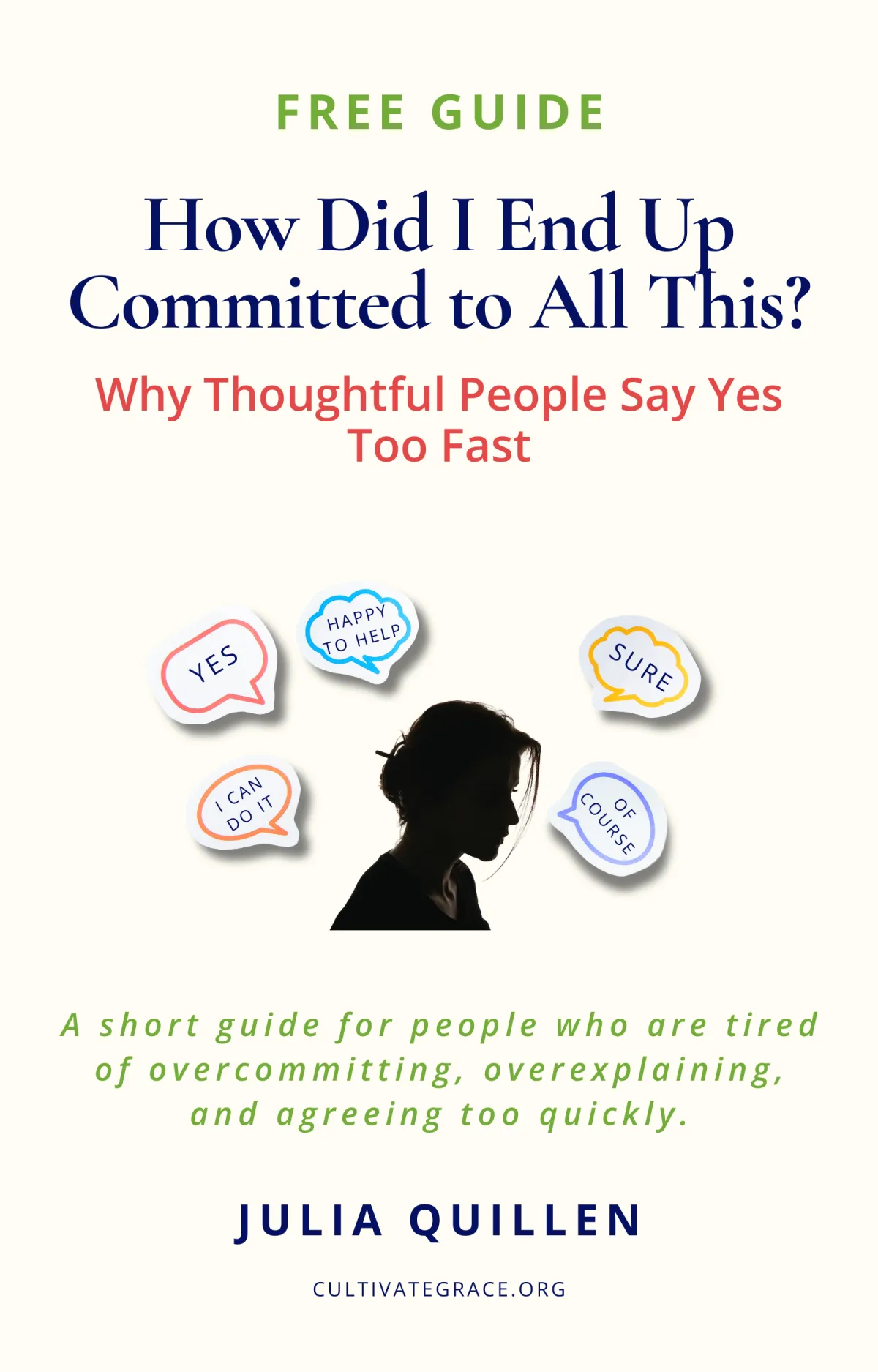
How Did I End Up Committed to All This? Why Thoughtful People Say Yes Too Fast— a short, free guide (eight pages)
Self-paced, single sitting read. Built as a lighter, faster entry point into the same territory as Before You Say Yes, this: gives the reader a reframe, a self-check list, and a first taste of the pause practice, without the full four-question filter or the deeper chapters on guilt and walking back a bad yes.
What it covers:
The reframe. She's not overcommitted because she's selfish, flaky, or bad at boundaries. She's overcommitted because she cares deeply, hates awkwardness, and keeps assuming future-her will have more energy. Overwhelm here isn't a character flaw, it's what happens when someone prioritizes people over her own capacity.
A reflection page. Six prompts to fill in by hand: what drains her most, which yeses came from guilt or flattery, what she keeps agreeing to that she secretly resents.
Because your next yes deserves more than an automatic answer.
The real reason behind the yes. A quick yes is often not about the thing itself. It's about relieving discomfort, avoiding guilt, or wanting to be seen as dependable. The guide walks through the same request-to-regret pattern from the book (request, discomfort or flattery, quick yes, relief, then regret and resentment), so she can see the mechanism in her own life.
A self-check list. Fifteen concrete signs she's saying yes too fast, agreeing before checking her calendar, overexplaining her no, feeling trapped by commitments she technically chose, so she can recognize the pattern in specific, familiar moments rather than in the abstract.
A first pass at the pause. A handful of low-drama holding phrases ("Let me check a few things first," "I need to think about that") and five questions to ask herself once she's bought that pause, do I actually want this, do I realistically have capacity, am I saying yes from desire or discomfort.
Ultimate outcome: She leaves with language for what's actually happening when she overcommits, and a taste of the pause practice, enough insight and enough of a felt shift to want the fuller framework.
The bridge: The guide closes by pointing to Before You Say Yes (the full pause-and-filter method) and The Thoughtful No (40 scripts), then to Stop Living on What's Left Over as the guided experience for anyone who wants support to move from insight into action as she builds a new pattern.